The Mirror Doesn't Lie: What a Dramatic Salon Change Really Reveals About Who You're Becoming
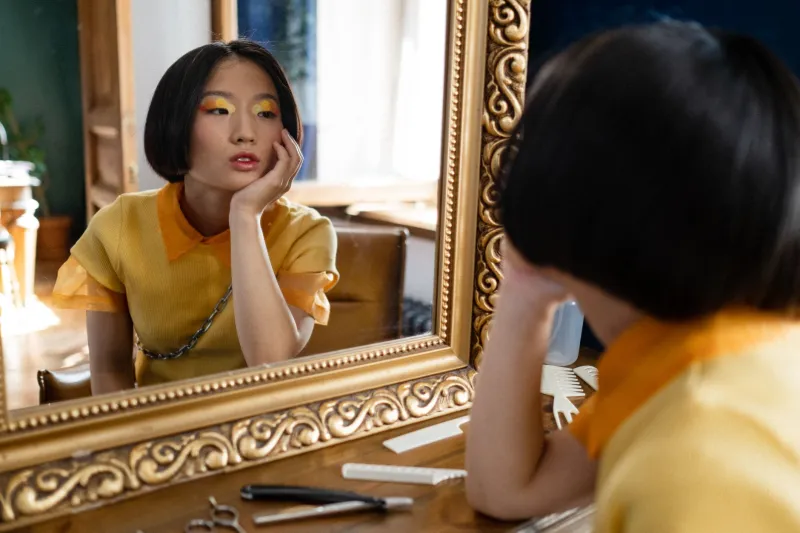
There is a reason people walk into a salon after a breakup, a promotion, or a move across the country. The decision to dramatically alter one's hair color or overall appearance is rarely about aesthetics alone. Psychologists, sociologists, and salon professionals alike recognize these moments of transformation as powerful acts of self-authorship — visible declarations of an interior shift that words alone cannot fully express.
Why We Change Our Appearance at Life's Turning Points
Human beings are meaning-making creatures. When the inner landscape shifts — through loss, achievement, liberation, or reinvention — the impulse to make that shift visible is both ancient and deeply rational. Anthropologists have long observed that cultures across history have used hair, adornment, and color as markers of life transitions: mourning, marriage, coming of age, and social elevation.
In contemporary American life, the salon has become one of the most accessible and socially sanctioned spaces for this kind of symbolic transformation. The act of sitting in the chair and communicating a desire for radical change is, in itself, a declaration of agency. It says: I am choosing something new.
Dr. Carolyn Mair, a behavioral psychologist specializing in fashion and appearance, has noted that changes in physical presentation are often the first visible expression of an identity shift that has already begun internally. The salon visit, in this reading, is not the cause of transformation — it is its announcement.
The Color Dimension: What Shade Choices Signal
Color psychology is a well-established field, and its principles extend naturally into the realm of hair color. The shades people choose — or abandon — at pivotal life moments are rarely arbitrary.
Consider the professional who spends a decade in a conservative corporate environment maintaining a natural brunette tone, then pivots to a creative industry role and immediately books an appointment for a bold copper or platinum transformation. The color change is not merely aesthetic self-expression; it is a renegotiation of identity in a new social context. The new shade signals to colleagues, clients, and — perhaps most importantly — to the individual themselves, that a new chapter has begun.
Conversely, the person who has spent years experimenting with vibrant, unconventional color and then transitions to rich, polished natural tones may be signaling a desire for a different kind of visibility — one rooted in authority, stability, or personal depth rather than playful rebellion. Neither trajectory is more or less valid; both reflect the profound way in which color functions as a language of the self.
At Belsi Salon, colorists regularly observe this phenomenon firsthand. Clients rarely arrive saying, "I am going through a major life transition." More often, they arrive with a photograph and an energy — a restlessness, a readiness, an urgency — that experienced professionals learn to recognize as something larger than a color preference.
Real Transformations, Real Stakes
The stories that emerge from salon chairs across the country share certain recurring themes. A woman in her early forties who spent her marriage keeping her hair long and natural because her partner preferred it, and who arrived for a pixie cut the week her divorce was finalized. A man in his late thirties who had maintained a clean-cut appearance throughout a career in finance, and who — upon launching his own business — grew out his hair and added texture, signaling to himself and others that the rules had changed.
A graduate student preparing for her first academic conference who requested a sophisticated, structured blowout and a refined makeup consultation — not because she doubted her research, but because she understood intuitively that how she presented herself would shape how her ideas were received. She was not being superficial. She was being strategic.
These moments illuminate an important truth: the salon is one of the few spaces in modern life where personal reinvention is not only permitted but actively facilitated. The stylist becomes a collaborator in the construction of a new self-image, working with both technical skill and interpersonal sensitivity to help the client arrive at something that feels authentically theirs.
The Confidence Loop: How Transformation Compounds
Research in social psychology has consistently demonstrated a bidirectional relationship between appearance and confidence. How we present ourselves influences how others respond to us, and those responses in turn shape our self-perception. This feedback loop — sometimes called the "enclothed cognition" effect in academic literature — operates equally powerfully in the realm of hair and beauty.
When a salon transformation is well-executed and personally resonant, the psychological effects extend well beyond the appointment itself. Clients report standing differently, speaking more assertively, and making decisions with greater conviction in the days and weeks following a meaningful change. These are not imagined effects. They reflect the genuine cognitive shift that occurs when the external self more closely mirrors the internal one.
This is precisely why the consultation process at a luxury salon matters so profoundly. A skilled stylist does not simply execute a technical request — they engage with the client's narrative, asking questions that surface the emotional context behind the desired change. Understanding that a client is preparing for a major job interview, recovering from a significant loss, or celebrating a hard-won personal milestone allows the professional to calibrate not just the technique, but the entire experience.
Makeup as Punctuation, Not Mask
The transformation conversation extends naturally into makeup, where the psychology of color and form operates with equal complexity. The client who has worn the same neutral palette for years and suddenly requests a bold lip or a dramatic eye contour is often processing a shift in how visible she wishes to be — a desire to take up more space, to be seen differently, to claim a more assertive presence.
Conversely, the client who moves away from heavy contouring toward a luminous, skin-forward look may be signaling a desire for authenticity over performance — a reconciliation with the self rather than a projection of an aspirational image.
A skilled makeup artist at a luxury salon reads these signals and responds with both artistry and discretion, guiding the client toward choices that serve their emerging identity rather than simply replicating a trend.
The Salon as Sacred Space for Self-Discovery
What makes the salon uniquely suited to these moments of transformation is the combination of skilled expertise, genuine attentiveness, and the simple permission to be seen. In a culture that often treats appearance changes as vanity, the luxury salon quietly holds a different understanding: that how we present ourselves is one of the most intimate and consequential choices we make.
At Belsi Salon, every transformation — whether a subtle shift in tone or a complete reinvention of style — is treated with the gravity it deserves. Because the person sitting in the chair is not just changing their hair. They are, in some essential way, stepping into the next version of themselves.